
Gerrymandering challenges keep rising
When a group of Michigan voters filed a complaint in December over partisan gerrymandering, it brought to seven the number of such challenges filed since 2016 and fueled hope that the U.S. Supreme Court will not only agree the practice is unconstitutional but also offer guidance for how to draw district lines.
Read more
February 07, 2018
Kris Kobach Proposed Weakening Key Federal Voting Protections In Trump Meeting- Huffington Post
Kansas Secretary of State Kris Kobach (R) brought a memo proposing to weaken voter protections in a major federal voting law to a meeting with President Donald Trump last year.
Kobach presented Trump with the proposal to amend the 1993 National Voter Registration Act, which requires state motor vehicle and other public assistance agencies to offer registration opportunities. Last year, the U.S. Court of Appeals for the 10th Circuit stepped in to block Kansas’ proof-of-citizenship requirement ahead of the election, saying it violated the NVRA.
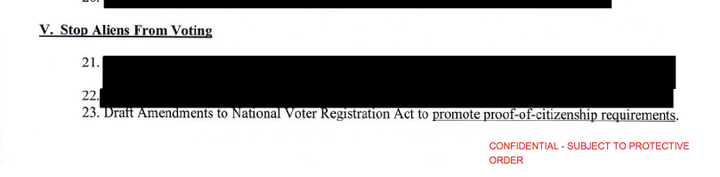
The proposal was at the bottom of a document Kobach was photographed holding during a meeting with Trump in November of last year. The document outlined Kobach’s plan for the first 365 days for the Department of Homeland Security in the Trump administration. In section 5 of the document, titled “Stop Aliens From Voting,” Kobach proposed: “Draft Amendments to National Voter Registration Act to promote proof-of-citizenship requirements.”
In another document, a memo sent to the head of the elections division in his office, Kobach outlined more details about how he proposed to amend the law. He wanted to eliminate a provision that doesn’t allow officials at motor vehicles agencies to ask for any information on a voter registration application beyond what is required on a driver’s license application. The memo suggested adding a provision in the law clarifying that it didn’t prevent states from asking about a proof of citizenship requirement.
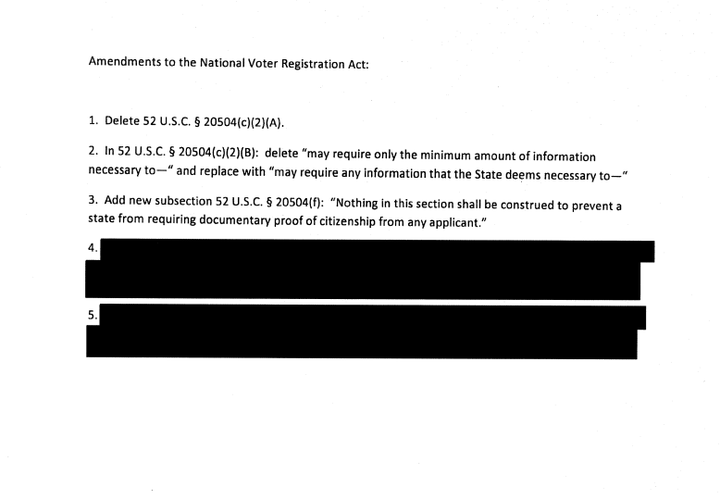
The document was made public Thursday when it was unsealed in ongoing litigation with the American Civil Liberties Union over a law in Kansas that requires Kansans to prove their citizenship in order to vote. Kobach has vigorously fought to block the documents from becoming public, and was sanctioned with a $1,000 fine and ordered to sit for a deposition after misleading the court about the contents of the documents.
The disclosure is significant because Kobach is leading a probe convened by Trump to investigate voter fraud. Despite Kobach’s history of exaggerating the pervasiveness of voter fraud and pushing restrictive voting policies in Kansas, the panel has pledged to be neutral. A document detailing Kobach’s intention to amend federal voting law will lend fuel to critics who say the probe is the beginning of an effort to implement more restrictive voting policies.
“We are grateful that the Court ultimately rejected Mr. Kobach’s months-long efforts to hide this information from the public,” Orion Danjuma, an attorney for the ACLU, said in a statement. “The public has a right to know the truth about Mr. Kobach’s lobbying efforts and the truth behind his claims,”
“Kris Kobach is public enemy number one when it comes to voter suppression in the country, which is why courts have repeatedly ruled against him,” Dale Ho, director of the ACLU’s voting rights project, said in a statement. “The documents unveiled today show that he wants to dismantle the motor-voter law and replicate his voter suppression practices ― which have disenfranchised thousands of Kansans ― around the country.”
October 06, 2017
The Few Democrats on Trump’s Voter Fraud Panel Push Back- Bloomberg-Businessweek
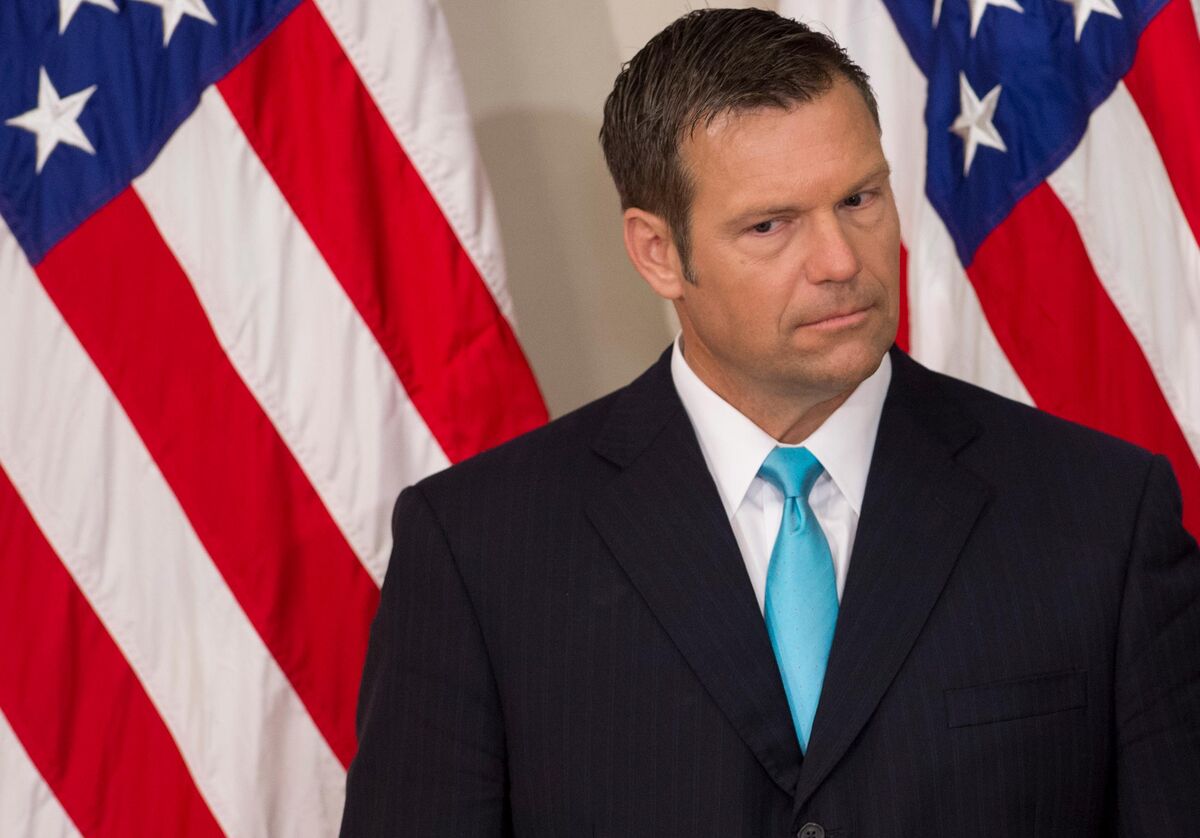
Kansas Secretary of State Kris Kobach listens as President Trump speaks at the first meeting of the Presidential Advisory Commission on Election Integrity in Washington on July 19, 2017.
Photographer: Saul Loeb/AFP/Getty Images
There’s a story that’s been going around over the past several months about busloads of people from Massachusetts driving into New Hampshire to vote illegally in last year’s election. President Trump told it to a group of senators in February, as part of a story about why he lost in New Hampshire. The head of his voter integrity panel, Kansas Secretary of State Kris Kobach, alluded to it in a Sept. 7 article on Breitbart.com. He also cited data made public by New Hampshire’s Republican House speaker that more than 5,000 people with out-of-state driver’s licenses had voted in New Hampshire in November. In his Breitbart piece, Kobach used those statistics to conclude that the outcome of the state’s Senate election, won by Democrat Maggie Hassan, and the awarding of its four electoral votes, which Hillary Clinton won by 0.4 percent, were “likely changed through voter fraud.”
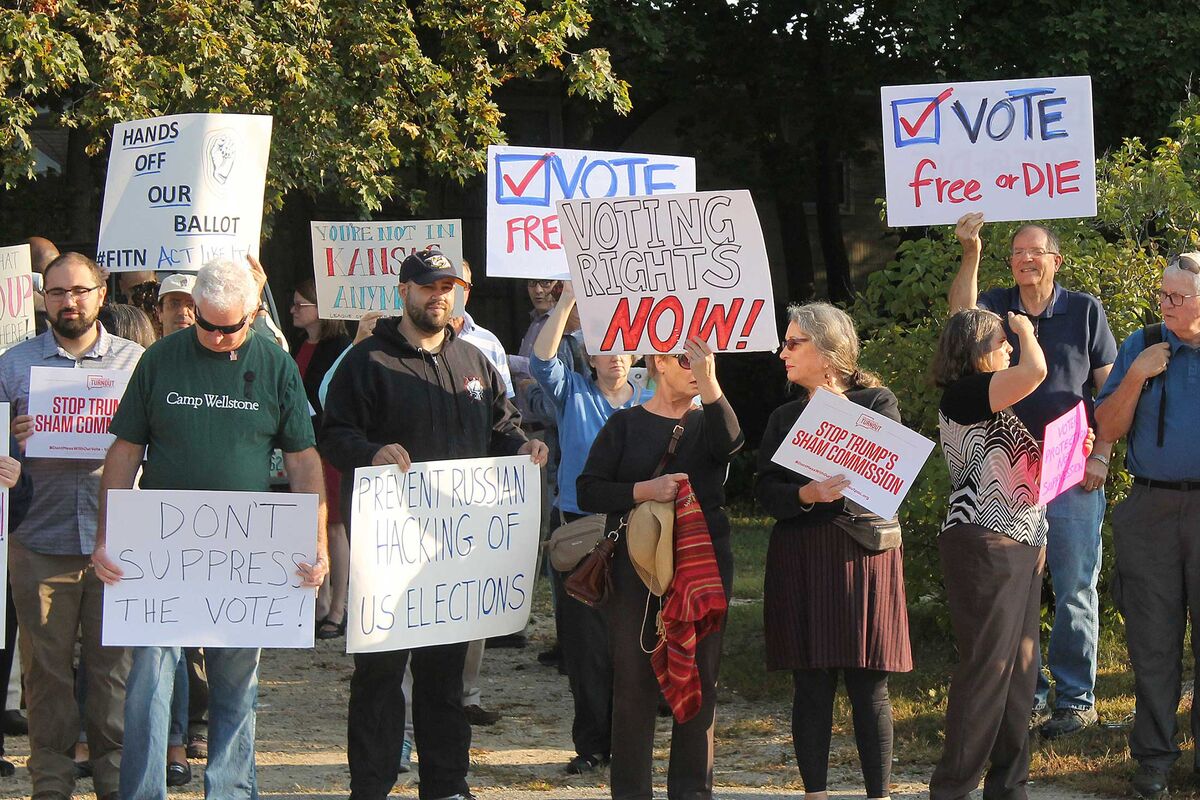
The issue came to a head this month during the second meeting of the election integrity commission, which just so happened to be held in New Hampshire. The event, at Saint Anselm College in Manchester, did not lack for conflict and gave the first indication of the divisions that exist among panel members. With protesters outside waving “Vote Free or Die” banners, Kobach was lambasted by two of the committee’s Democratic members, including Gardner, for his assertion that the state was the victim of widespread voter fraud that tipped elections in Democrats’ favor.
Gardner criticized Kobach’s contentions, grousing that the numbers cited in his article “don’t create proof.” Moments later, Maine Secretary of State Matt Dunlap, probably the commission’s most outspoken critic, said that drawing a connection between out-of-state licenses and voter fraud was tantamount to claiming money found in a wallet is the result of bank robbery. “I think that’s a reckless statement to make,” Dunlap said.
By then, another Democratic member, Alabama Probate Judge Alan King—who was absent from the Manchester meeting—had submitted a five-page memorandum detailing his concern that the commission was looking for ways to keep people from voting. King’s memo lent an insider’s voice to the worries of many voting rights activists that the panel’s Republican majority is simply using it to assemble the justification for adding restrictions to America’s voter registration and balloting process. Earlier this year, Kobach was fined $1,000 by a U.S. judge who found he’d misled the court about the contents of a document he shared with then-President-elect Trump about possible changes to federal voter registration law. Kobach has long advocated adding a proof-of-citizenship requirement to registration forms.
“This is a pretty partisan commission,” said Ohio State University election law professor Daniel Tokaji. “I guess there are a couple of people at least with Democratic affiliations. They’re certainly not prominent people in this elections sphere, nor, to this point, have they been particularly vocal in raising the other side of this debate.”
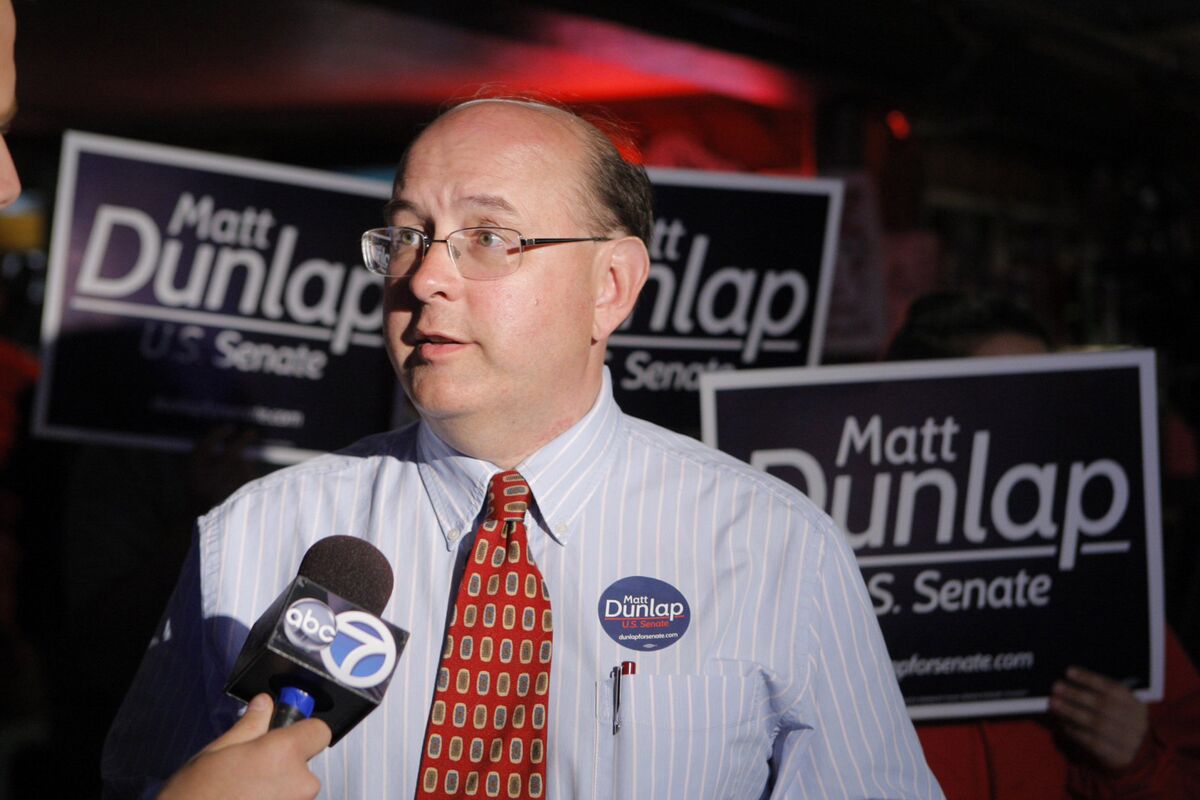
“I know we are outnumbered,” said Democrat David Dunn, a commission member and former Arkansas legislator who has been urged by acquaintances to step down but has so far refused. “Why would you resign?” he said. “Why would you turn it over to the exact people that you’re afraid of doing something that would harm your access to the polls?” Wood County, W.Va., Clerk Mark Rhodes missed the Manchester gathering and the attendant fireworks due to a scheduling conflict. He called the dissension a positive. “Differences of opinion turn out to make good discussions,” he said, adding that he’s comfortable with the commission’s work, as long as it’s based on fact, not opinion.
At least one of the panel’s Republican members was concerned about including Democrats. While commission members met and argued in Manchester, a Washington-based watchdog group made public an email written by von Spakovsky in February—prior to the members’ selection—that eventually made its way to U.S. Attorney General Jeff Sessions. In it, von Spakovsky bemoaned plans to make the panel bipartisan, stating, “There isn’t a single Democratic official that will do anything other than obstruct any investigation of voter fraud.”
Even mainstream Republicans, he said, were likely to be insufficiently familiar with the issues in play, ensuring the body’s efforts would end in “abject failure.”
Responding through a foundation spokeswoman to a request for comment, von Spakovsky backed away from his strident tone, stating in part, “After my own participation as a member, I’m confident that all the members of the Commission are committed to uncovering the truth about election integrity and the other issues present in our election system and developing recommendations to safeguard and improve the voting process.”
Despite the lack of evidence that fraud is a widespread problem, the issue of tightening access to the polls reverberates among most voters. An August 2016 Gallup poll found that 80 percent of Americans support voter ID laws. And, sparked by Republican dominance of state governments and the 2013 U.S. Supreme Court decision to gut Section 5 of the Voting Rights Act, conservative legislators are making a sustained effort to pass more restrictive voting laws. In 2017, 35 bills that would have made it more difficult to vote in 17 states made it past the committee level, according to a survey by the left-leaning Brennan Center for Justice.
Trump’s voter commission still has almost two years to complete its work and submit a report to the president. The nightmare scenario for the commission’s critics is that it will release a final report contending that there’s rampant voter fraud in the U.S. and inadequate means to detect or prevent it. Such a report could be a springboard for Congress to enact tougher, more-restrictive rules at the national level similar to what’s been done in a handful of states.
Dunn, the Democratic commission member and former Arkansas legislator, said that the restrictive law passed in Arkansas was driven not by actual voter fraud but by the belief that people were casting ballots illegally. Dunn criticized the state’s new voter ID law, saying the burden would fall most heavily on those who don’t have the requisite identification and for whom simply going to get one would be a hardship.
While Dunn said he hopes his presence on the panel will help steer the debate toward those issues, Maine’s Dunlap put it more plainly: “If you’re not at the table, you’re on the menu.”
<iframe src='https://www.googletagmanager.com/ns.html?id=GTM-MNTH5N' height='0' width='0' style='display:none;visibility:hidden'></iframe>
September 29, 2017
America's shameful history of voter suppression - The Guardian
Voter fraud is more rare than being struck by lightning, yet the fear-mongering persists. Don’t blame Donald Trump – blame America’s democratic model
by Andrew Gumbel in Los Angeles
When Kris Kobach was first running for office in Kansas in 2010, he claimed he’d found evidence that thousands of Kansans were assuming the identities of dead voters and casting fraudulent ballots – a technique once known as ghost voting.
Kobach even offered a name, Albert K Brewer of Wichita, who he said had voted from beyond the grave in the primaries that year.
But then it emerged that Albert K Brewer, aged 78, was still very much alive, a registered Republican like Kobach, and more than a little stunned to be told he’d moved on to the great hereafter. No evidence emerged that anyone had ghost voted in Kansas that year.
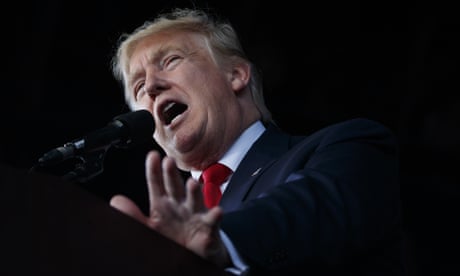
On the contrary. Backed by a president who, days after assuming office, claimed that 3 to 5m million fraudulent ballots had been cast for Hillary Clinton, Kobach is enthusiastically spreading stories of voter impersonation on a massive scale, of out-of-state students voting twice, and of non-citizens casting illegal ballots.
As vice-chair of the Presidential Advisory Commission on Election Integrity, his mission to root out “fraudulent voter registrations and fraudulent voting” is sending chills down the spines of election experts and voting rights activists who believe he is intent on instituting a sweeping wave of new voter suppression laws.
Kris Kobach, vice-chair of the Presidential Advisory Commission on Election Integrity, at Trump International Golf Course. Photograph: Drew Angerer/Getty Images
Vanita Gupta, who headed the justice department’s civil rights division under President Obama, calls the commission “a pretext … to kick millions of eligible voters off the rolls and undermine the sanctity of our election systems”. Already in conjunction with a commission hearing in New Hampshire on Tuesday, a Kobach ally proposed instituting a system of background checks on voters as strict as the checks liberal groups want to impose on gun buyers.
Kobach did not respond to an interview request from the Guardian.
While it may seem astonishing to see such tactics being deployed in the world’s most powerful democracy, they cannot be attributed solely to the rise of Trump. In truth, the politics of electoral combat have been heating toward boiling point for a decade and a half – and are the product of a political system that has never, in more than two centuries, resolved basic questions of democratic accountability and is thus unique in the developed western world.
The 2000 presidential election, and in particular the bruising 36-day fight over Florida’s votes, exposed flaws in the US electoral system that many Americans had not thought about since the end of segregation and the landmark achievements of the civil rights era.
Not only was there a problem of reliability with the voting machines, it also became clear that the United States had never established an unequivocal right to vote; had never established an apolitical, professional class of election managers; and had no proper central electoral commission to set standards and lay down basic rules for everyone to follow free of political interference.
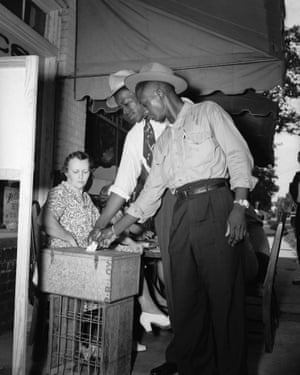
In Mississippi, two African American men vote for the first time in the 1946 Democratic primary. Many southern states have persisted with Jim Crow-era laws the disproportionately impact black voters. Photograph: Bettmann/Bettmann Archive
In the absence of such a body, every jurisdiction was free to play fast and loose with the rules on everything from voter eligibility to whether or not to conduct recounts.
“All these different systems in different counties with no accountability … it’s like the poorest village in Africa,” the chair of South Africa’s Independent Electoral Commission, Brigalia Bam, later exclaimed on a follow-up tour of Florida on the eve of the 2004 presidential election.
Much of that dysfunction harks back to the country’s shameful racial history. To circumvent constitutional amendments passed in the wake of the civil war, southern states approved a slew of discriminatory laws and introduced literacy tests and good character tests (also adopted in parts of the north) that made it next to impossible for blacks to vote. James Vardaman, the despotic governor of Mississippi, admitted in 1890 that his state’s new constitution had “no other purpose than to eliminate the nigger from politics”.
Even after segregation and Jim Crow voting laws came to a formal end in the South, modern politicians remained susceptible to the temptations of racist dog-whistles as a way of mustering the support of white voters and justifying the restriction of minority voting rights. Many southern states, for example, have persisted with segregation-era laws banning felons and ex-felons from voting – a restriction that disenfranchised an estimated 6 million voters in 2016, a vastly disproportionate number of them black men.
The Republicans have been especially prone to such corruptions because they are now the natural ruling party in the south and they have resorted to a similar playbook to the segregation-era Democrats: stoking resentment of northern elites and harking back to the “lost cause” of the civil war. They have also become increasingly insecure about their ability to win national elections. Demographic shifts have eroded their overwhelmingly white base of support, and they have so far resisted repeated entreaties from party elders to broaden that support by moderating their policy positions.
Voter fraud was often invoked in the segregation era as an excuse to crack down on the rights of blacks and poor whites
In many states – notably North Carolina and Texas – they have exploited their majority in the state legislature to gerrymander congressional districts to their advantage. While both parties gerrymander, it has become surprisingly common for the Republican party to win fewer votes than the Democrats and still come out ahead in the House or Senate or both.
After the fight over the 2000 presidential race, the GOP’s response was not to sigh with relief that George W Bush squeaked into the White House, but rather to cry foul about African American voters being allowed to stay in line beyond the official poll closing time in St Louis and to initiate a long, vicious publicity drive to insinuate that voter registration drives in poor inner city neighborhoods were in fact corrupt enterprises to stuff voter rolls and ballot boxes on behalf of the Democrats.
Often, Republicans seemed to be evoking the era of New York’s Boss Tweed, when voting numbers were routinely padded by repeat voters, out-of-towners, foreigners, and phantom voters who were in reality pets, fictional characters, or stone-cold dead. Such practices, however, were sharply curtailed after the introduction of the secret ballot in the late 19th century and ceased to be a factor of any significance after the last of the corrupt big city machines was brought to heel and reformed in the 1970s and 1980s. Voter impersonation – of the type Trump has invoked – is not a significant factor, and study after study has shown that while individual voter fraud does occasionally occur, it is rarer than being struck by lightning.
The specter of voter fraud was often invoked in the segregation era as an excuse to crack down on the rights of blacks and poor whites, and so it has proved in this century.
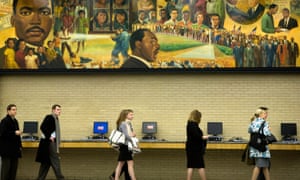
At the Martin Luther King Library in Washington, voters wait in line to vote in the 2008 presidential election. Photograph: Brendan Smialowski/Getty Images
In the wake of Barack Obama’s election in 2008, there was an epidemic of racially coded appeals to the electorate’s worst instincts, including insinuations that Obama was not born in the United States and that busloads of illegal immigrantshad poured over the Mexican border to seal his victory at the ballot box.
Party strategists, meanwhile, understood that to halt the pro-Obama momentum they had to stop minority voters and students from voting in such large numbers.
A government study has suggested that the introduction of stricter ID requirements could shave two to three percentage points off the Democratic party total.
One brake on this trend used to be the 1965 Voting Rights Act, passed at the height of the civil rights era, which gave the justice department veto power over any new election rule or law passed in parts of the country with a proven history of racial discrimination. But in 2013, this so-called preclearance provision of the act was scrapped when the supreme court decided in a hugely controversial 5-4 decision that racial discrimination was no longer pervasive enough in the south to justify it.
Immediately, southern states including North Carolina and Texas passed stunningly restrictive new voting laws that have since been denounced in federal court as openly discriminatory and in violation of Voting Rights Act provisions that are still in force.
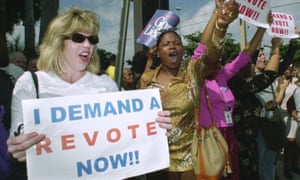
Demonstrators in Palm Beach County, Florida, demand a revote of the 2000 presidential election. Photograph: Marta Lavandier/Associated Press
Throughout this period, Kobach has not only offered his support to nationwide voter suppression efforts but has been a leader in pushing them as far as possible. In Kansas, where he is secretary of state, he pushed for and eventually obtained a “proof of citizenship” requirement – now being litigated in court – that risked disenfranchising an estimated 7% of eligible voters who do not have a passport or birth certificate.
Trump owes his political rise to many of the same impulses that have guided this trend in Republican politics. He was himself an enthusiastic “birther” and kicked off his presidential campaign with open appeals to anti-immigrant hostility. Even before the election he was warning of the risk of massive voter fraud and tying it in his supporters’ minds to the specter of out-of-control immigration policies.
All that helps explain the extraordinary alarm and anger that Kobach’s work with the presidential advisory commission has triggered.
When Kobach asked states to provide a dizzying array of data on individuals – including names, addresses, party affilliations, criminal history and more – the Republican secretary of state in Mississippi told him to “go jump in the Gulf of Mexico”. Shortly after, the National Association of Secretaries of State, which is majority Republican, put out a statement reaffirming its commitment to “increasing voter participation”.
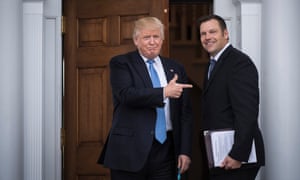
Donald Trump with Kris Kobach. Trump’s election integrity commission has been criticized as ‘a fraud’. Photograph: The Washington Post/Getty Images
“This commission is a fraud. And President Trump has chosen a fraud to be in charge of it,” a former secretary of state of Missouri, Jason Kander, said when it was established.
It explains, too, why the Senate minority leader Chuck Schumer – suddenly in the spotlight following last week’s cross-party deal on lifting the budgetary debt ceiling – saw the racist violence in Charlottesville, and Trump’s failure to offer a full-throated condemnation, as a reason to shut down the election commission.
In a piece published in late August, Schumer condemned the “methodical and pernicious way in which [Trump’s] administration is promoting discrimination, both subtle and not so subtle, in its policies and actions – especially when it comes to undermining the universal right of every American to vote”.
“The president’s ‘Election Integrity Commission’ and the actions of the attorney general are wolves in sheep’s clothing. They are a ruse. Their only intention is to disenfranchise voters.”
September 13, 2017
Good news for voters in Illinois!

Illinois became the 10th state, along with the District, to move to modernize its system of voter registration through automatic registration.
Read more
September 03, 2017
Indiana Kicks Voters Off the Rolls and Isn’t Telling Them - The Daily Beast

Daniel Acker/Bloomberg via Getty Images
A new Indiana law permits voters to be automatically removed from registration rolls without giving any notice or allowing for a waiting period for those purged to respond, and it could all be a mistake.
“No Hoosier should be silenced on Election Day,” Barbara Bolling-Williams, president of the Indiana State Conference of the NAACP, said in a statement. “Yet, under this new law, that will happen. It’s vital that Indiana follow federal law and ensure that voters are not wrongfully removed from the rolls.”
The suit takes issue with Indiana’s now-unbridled use of the controversial Kansas-based Interstate Crosscheck System, a database used in 27 states to identify potential voters registered in multiple states by comparing voter names and dates of birth.
Indiana adopted the database in 2014, when it was ushered in by then-Gov. Mike Pence. Officials at that time had to notify voters that they were at risk of being removed from voter rolls. A voter was removed only if they failed to respond and vote in the next election.
August 29, 2017
Editorial: Here's how to fix Indiana's rigged voting system -IndyStar
Editorial: Here's how to fix Indiana's rigged voting system
IndyStar Published 4:22 p.m. ET Aug. 26, 2017

Voters received an "I voted early" sticker after voting in advance of the November election(Photo: Kelly Wilkinson/IndyStar)
Let's be honest: Republicans have gamed Indiana's voting system to their advantage.
They gerrymandered congressional and legislative districts in their favor after the 2010 Census, helping the party gain supermajorities in the Indiana House and Senate. They've also suppressed the number of early voting sites in Democratic areas while encouraging their expansion in counties where Republicans dominate.
Consider that in Marion County, population 939,000, voters can cast early ballots at only one location, at the City-County Building in congested Downtown. Republicans repeatedly have blocked proposals to open more voting centers in Indy.
But in Hamilton County, population 309,000, voters enjoy the convenience of three early voting sites. And Republicans there, in a county where Democrats often struggle to field candidates, support opening more centers.
The results are not surprising. As IndyStar reporter Fatima Hussein documented, the number of early ballots has sharply increased in recent years in Republican-heavy Hamilton County and declined in Democratic-friendly Marion County.
Republicans didn't invent gerrymandering. Both parties have used it to their advantage over the years, including after the 2000 census when Indiana Democrats drew district maps heavily skewed in their favor.
And Republicans still would do well in the state even if we had a truly equal voting system. After all, Donald Trump won Indiana by 19 percentage points last year, and only one Democratic presidential candidate (Barack Obama in 2008) has won the state in the past 50 years. There's not much doubt that Indiana is a red state.
But the unequal voting system now in place is unacceptable in a state and nation built on the ideal that every eligible voter has a right to be heard.
What needs to change?
To start, the General Assembly should eliminate the requirement that county election boards reach unanimous agreement before opening an early voting center. That rule has let the lone Republican member of the Marion County board repeatedly block plans to add centers. The state also should take over responsibility for the cost of early voting; the current county-by-county funding leads to unequal access in different parts of the state.
It's also long past time for Indiana to create a bipartisan redistricting committee, responsible for redrawing congressional and legislative maps. More politically balanced districts would encourage higher voter turnout.
Gov. Eric Holcomb, House Speaker Brian Bosma and Senate leaders need to make the protection of voting rights a high priority as they craft their 2018 legislative agendas.
Equal access to voting is a core value in our democratic society. It needs to become a core practice in our state.
August 29, 2017
Politicians against voting: Trump's DOJ pushes a purge -NY Daily News

(Alex Brandon/AP)
What so troubles Donald Trump’s Department of Justice about the voting rolls in the critically important swing state of Ohio that it saw the need to abruptly switch sides in a voter purge case after six years?
In 2011, Ohio passed a law designed to “clean” its voter rolls. If a voter goes two years without casting a ballot, he or she receives a notice asking to confirm registration. If the voter fails to respond and doesn’t cast a ballot in the next four years, he or she is removed.
As a result, Ohio lopped more than 2 million people off the rolls between 2011 and 2016 — at least 1.2 million for “infrequent voting.”
Voting rights activists sued on the grounds that scratching names for inactivity alone was a violation of the 1993 National Voter Registration Act — and that the purges had a disparate impact on Democratic voters. In 2010, the Obama Justice Department issued an agency ruling that inactivity shouldn’t spark a purge. In 2016, DOJ filed an amicus brief on behalf of Ohio’s advocates.
Now, with the Supreme Court about to hear the case, the DOJ under Attorney General Jeff Sessions has switched sides.
Especially when seen as part of a pattern, the move reeks.
In February, DOJ ended its challenge of a restrictive Texas voter ID law.
The administration also created a so-called voter integrity panel which seems designed to give Kansas Secretary of State Kris Kobach ammunition to craft national standards that will make it easier for Republican-dominated legislatures to put more obstacles in voters’ paths while instituting purges of their own.
Ironically, Trump credits his victory in typically Democratic states like Pennsylvania, Michigan and Wisconsin to bringing low-propensity voters back to the polls.
The answer to inactive voters isn’t to kick them off the rolls — it’s to give them something, and someone, to vote for.
August 14, 2017
Republicans limiting early voting in Marion County, letting it bloom in suburbs -Indy Star
Fatima Hussein, [email protected]

Absentee voting in Hamilton County grew in 2016 with the addition of early polling places. Why was Marion County limited to just one? Stephen J. Beard /IndyStar
State and local Republicans have expanded early voting in GOP-dominated areas and restricted it in Democratic areas, an IndyStar investigation has found, prompting a significant change in Central Indiana voting patterns.
From 2008 to 2016, GOP officials expanded early voting stations in Republican dominated Hamilton County, IndyStar's analysis found, and decreased them in the state's biggest Democratic hotbed, Marion County.
That made voting more convenient in GOP areas for people with transportation issues or busy schedules. And the results were immediate.
Most telling, Hamilton County saw a 63 percent increase in absentee voting from 2008 to 2016, while Marion County saw a 26 percent decline. Absentee ballots are used at early voting stations.
Population growth and other factors may have played a role, but Hamilton County Clerk Kathy Richardson, a Republican, told IndyStar the rise in absentee voting in Hamilton County was largely a result of the addition of two early voting stations, which brought the total to three.
Other Central Indiana Republican strongholds, including Boone, Johnson and Hendricks counties, also have added early voting sites — and enjoyed corresponding increases in absentee voter turnout.
But not Marion County, which tends to vote Democratic, and has a large African-American population.
During that same 2008-16 period, the number of early voting stations declined from three to one in Marion County, as Republican officials blocked expansion.
Some Republicans blame the dearth of early voting in Marion County on a lack of local funding. "I have never received any type of message that the individuals in charge of Marion County have any interest in spending the money (to expand satellite locations)," said Jim Merritt, chairman of the Marion County Republican Party.
“It is a deliberate attempt by certain people in our government to make voting hard,” said former Marion County Clerk Beth White, a Democrat, who promoted those expansions.
Whatever the motives, it's a partisan squabble with serious ramifications for a democratic system already strained by claims of foreign tampering and fake news, not to mention presidential candidates describing the system as "rigged."
Democrats are challenging the state's early voting system in a lawsuit alleging the secretary of state and legislative supermajority have launched a concerted effort to suppress the Democratic vote, a debate that is also playing out on the national front.
When presented with IndyStar's findings, Richardson, who also serves on the Indiana House Elections Committee, said she would support additional early voting sites in Marion County, as well as statewide funding of elections to ensure a more equitable system. But she doubted state funding would receive political support.
When asked about IndyStar's analysis, legislative leaders including Indiana Senate President Pro Tempore David Long, R-Fort Wayne, and House Speaker Brian Bosma, R-Indianapolis, did not return numerous requests for comment, or respond to questions submitted in writing. Indiana Gov. Eric Holcomb and Secretary of State Connie Lawson deferred to county officials for comment.
Julia Vaughn, executive director of Common Cause Indiana, which is party to the suit, said in-person early voting is important because people are increasingly voting early — especially the poor and people of color who cannot take time off of work.
And the recent history of voting reforms strongly suggests new state policies contributed to the disparity in early voting opportunities now seen in Central Indiana.
Protecting the voter, protecting the polls
Since legislation passed in 2001, every county requires a unanimous vote of the three-member board to expand early voting. County elections boards are currently made up of a Democrat, a Republican and the county clerk. That legislation set the stage for the current disparity.
But it wasn't until 2008 until the issue developed. Shortly after the U.S. Supreme Court upheld Crawford v. Marion County in April 2008, mandating all Indiana voters present government-issued ID at the polls, the Marion County Election Board approved early voting sites in the state’s largest county.
In October 2008, two satellite voting locations opened in Marion County at North Central High School on East 86th Street and the Southport Community Center on Derbyshire Road, along with the City-County Building Downtown.
The selections were based on recommendations from a bipartisan study committee and approved unanimously by the Marion County Board of Elections that summer, according to court documents filed with the U.S. District Court for the Southern District of Indiana.
In November 2008, Barack Obama was elected president and was the first Democrat to carry the state of Indiana since Lyndon B. Johnson in 1964 — heavily supported by Lake and Marion counties, which both have large, Democratic, African-American populations.

In 2010, the Marion County Election Board, ceased approving satellite voting sites in federal elections due to the objections from the Republican member of the board. The Republican member of the board did so again in 2012, when the board considered a resolution that would have created two additional satellite sites, one at the Beech Grove Technology Center and another at the Washington Township Trustee’s office.
The two Democratic members approved the locations, and GOP member Patrick Dietrick cast a vote against it.
In 2013, the state legislature began implementing reforms with specific controls over Marion, Lake and Allen counties' early voting systems.
The legislature enacted IC 3-11.5-4, which applied to “counties with populations over 325,000," mandating that absentee ballots must be counted at a central site, "unless a county election board could unanimously agree to do so elsewhere."
White, who was clerk at the time, warned that the bill, Senate Bill 621, would make voting more expensive in those counties.
"Indiana’s other 89 counties still retain the flexibility to decide whether or not to send ballots to their precinct to be counted or count them at a central site," she argued in 2013. "In effect, county election officials will be operating under two sets of rules."
Again, in 2014 and 2016, Democrats attempted to expand early voting in Marion County, but were stopped by the Republican member of the election board. Most recently, Republican Maura Hoff, by proxy, cast a vote against expanded early voting sites. Hoff did not respond to emails, phone calls and written requests for comment.
Meanwhile, Hamilton County added two additional early voting stations in 2016, giving it one station for every 100,000 voters, as opposed to one for more than 700,000 voters in Marion County. The results were significant.
The number of in-person absentee ballots cast in Hamilton County rose from 32,729 in 2008 to 53,608 in 2016, representing a 63 percent increase. At the same time, there was a 26 percent decrease in Marion County, from 93,316 to 68,599. During that period, the percentage of absentee ballots rose from 25 percent to 34 percent in Hamilton County, and fell from 24 percent to 19 percent in Marion County.

Early voting at the City-County Building, Indianapolis, Wednesday, Oct. 12, 2016. (Photo: Robert Scheer/IndyStar)
"This is a clear way to make it more strenuous for people to vote," adding that she has seen similar tactics used in Texas, North Carolina and Kansas.
What's more, the uneven playing field is likely to become even more exaggerated in years ahead. GOP leaders admitted in court testimony that a project in Downtown Indianapolis is disrupting parking at Marion County's only early voting station.
In May, Common Cause Indiana and the NAACP’s Indianapolis chapter filed a lawsuit against the Marion County Election Board, Lawson and individual members of the Marion County Election Board, along with Marion County Clerk Myla Eldridge over the lack of early voting locations in the County.
They say the state has intentionally discriminated against minorities in forming these rules.
The individual members of the election board did not respond to IndyStar requests for comment. Eldridge declined to comment to IndyStar.
Republicans argue that there has been no effort over the years to suppress the vote in Marion County.
Richardson in Hamilton County says while she sees the benefits of early voting locations — it will be difficult to change the law allowing local decision-making. "The only way it could be equal is if the state took over the operations of elections and I don’t believe that will happen."
“We need to give voters options, whether they choose to exercise them or not,” Vaughn said. “This is about a disparity that exists where voters in other counties have more opportunities than voters in Marion County.”
Will vote centers solve the problem?
The latest reforms being floated include vote centers, but the effect of those is also debatable.
The centers would do away with neighborhood precincts and drastically reduce the number of voting locations throughout the county and state.
A study by Pew Charitable Trusts indicates that vote centers are on the rise throughout the nation, from Colorado to Iowa and the District of Columbia.
In Indiana, from 2007 to 2010, the secretary of state's office ran a Vote Center Pilot Program. Three counties — Wayne, Tippecanoe, and Cass — experimented with the use of vote centers.
After three years and numerous elections, “the pilot program was a success,” according to the secretary of state website, and in 2011, the Indiana General Assembly passed Senate Enrolled Act 32 and House Enrolled Act 1242, making vote centers an option for any Indiana county.
According to the National Conference of State Legislators, there are a variety of positive and negative aspects to vote centers:
Positively, citizens can vote near home, near work or school, or anywhere there is a vote center. With fewer locations to staff, election day expenses are reduced and, because of convenience, turnout may increase.
However, vote centers can cause confusion if the switch isn't well publicized and explained to the public. The centers also change the traditional civic experience of voting with neighbors at a local school, church or other polling place.
Most important, the switch could drastically reduce the number of early voting locations throughout the county, the website states.
And efforts by some Republicans to establish vote centers died this year in the Republican-controlled legislature.
In the latest legislative session, Rep. Tim Wesco, R-Elkhart, proposed a vote centers bill that would have applied to the entire state, but the bill died before it could be discussed.
Merritt and other Republicans say Democrats have not been open to adding vote centers.
 Buy Photo
Voters make their way through the queue during the first day of early voting at the City-County Building in Indianapolis, Wednesday, Oct. 12, 2016. (Photo: Robert Scheer/IndyStar)
“This is the most basic part of the democratic process," she said.
"If we are not adding more additional early voting locations here, we don’t have our priorities in the right place.”
Call IndyStar reporter Fatima Hussein at (317) 444-6209. Follow her on Twitter: @fatimathefatima.
August 10, 2017
Lawsuit: Indiana law forcing precinct consolidation violates voters' rights -Gary Post Tribune/Chicago Tribune
A federal lawsuit filed Wednesday claims a new Indiana law forcing small precinct consolidation in Lake County is a violation of voters' rights.
The Indiana State Conference of the National Association for the Advancement of Colored People and a group of Lake County residents said, in the lawsuit, the forced consolidation of voting precincts with fewer than 600 voters "places severe, undue burdens on one of the most fundamental rights guaranteed to citizens in our representative democracy: the right to vote."
Priorities USA Action, a political action committee founded by two former aides for President Barack Obama, is supporting the lawsuit as a part of its work to protect voting rights.
The suit was filed Wednesday in federal court in Hammond, by Perkins Coie, a Washington, D.C.-based law firm, shortly before the Indiana Elections Commission's regular meeting where officials were set to take up the issue of Lake County's small precinct consolidation plan. County election officials had until Aug. 1 to file a consolidation plan. That plan was not filed.
Lake County Democratic Central Committee Chairman Jim Wieser said a plan was not filed in anticipation of the lawsuit that has been in the works since April. He said a chance meeting with a lobbyist he knew led to a connection with a national client that was interested in the case on civil rights grounds.
"I feel that this is an unbelievable opportunity for us, for the Democratic Party in Lake County, for Democratic voters in Lake County, for all voters in Lake County," Wieser said.
"I don't know what the next step will be," Dernulc said.
Dernulc declined to comment on the lawsuit saying he had yet to see the complaint.
"People have a right to sue. I just think this law and legislation have good standing," Dernulc said. There is also the Indiana Supreme Court ruling in favor of the 2014 law.
"Anybody can file a lawsuit," Dernulc said, adding it does not mean the plaintiffs will win.
The lawsuit claims consolidation would target 294 of the county's 522 voting precincts, according to court documents, and those slated to be combined are in northern Lake County, specifically "minority-majority" Gary, East Chicago and Hammond.
"By eliminating precincts in northern Lake County in particular, the law will cause voter confusion and force voters to travel longer distances to vote, severely burdening the right to vote for precisely those voters least likely to be able to carry that burden," the lawsuit said.
The new law requires Lake County to develop a plan to consolidate voting precincts with fewer than 600 active voters. The legislation gave the county until June 1 to submit its plan to the state or the Indiana Election Commission would make its own plan to consolidate Lake County's precincts. Wieser said that deadline was extended to Aug. 1.
Wieser said he received the extension of the deadline to file a small precinct consolidation plan with the Indiana Elections Commission but had no intention of filing a county plan and "did not want to give any credence whatsoever to the legislation."
During the recently convened session, the bill was entered into the Senate by Sen. Rick Niemeyer, R-Lowell, after identical legislation by Rep. Hal Slager, R-Schererville, failed to move out of the Elections and Apportionment Committee in the House of Representatives in February. Niemeyer's bill passed the Senate 38-11 and the House of Representatives 59-30.
Gov. Eric Holcomb signed the bill on May 2.
In May, Lake County Election Board of Elections and Voter Registrations Chairman Kevin Smith said he didn't think the governor and state gave Lake County enough time to develop a good consolidation plan, a concern shared by Wieser. The pair worked to provide information to Perkins Coie for the lawsuit.
Slager had put in a similar bill in 2014, which passed, but wound up being challenged by Lake County Sheriff John Buncich, then chairman of the Lake County Democratic Central Committee. That lawsuit argued the bill was special legislation as it only targeted Lake County, according to court documents, and a lower court initially agreed with that.
Ultimately, the Indiana Supreme Court ruled against Buncich's challenge, saying the consolidation bill was not special legislation. By the time the court had ruled, the legislation had expired and Lake County did not do any of the precinct consolidation the bill sought.
Wieser said the new suit is being filed on the grounds the law violates Section 2 of the Voting Rights Act and creates an undue burden on the right to vote. He said the suit also claims a violation of equal protections in that it unfairly burdens and targets voters in one county instead of all.
In addition to making it difficult for voters, among the factual arguments is the vast majority of the voters affected are minorities, the elderly and voters with disabilities.
Wieser said he understands the need to consolidate precincts and said the election board had planned on doing so this year, which is an off election year with no regularly scheduled elections. He said he resents the state forcing a drastic consolidation on the county and only on Lake County in the name of saving money.
"Let's take a scalpel, not a chainsaw to it. Let's do it in a less draconian manner," Wieser said. He said none of the legislators who introduced the legislation in the House or Senate had reached out to talk to him prior to submitting their bills.
Wieser said the legislation, touted as a cost-savings measure, takes away not only the local election board's ability to operate as local leaders see fit, but it takes away the ability from the county council to decide how it uses taxpayer dollars. Both bodies are Democratic majorities. The state Legislature is under Republican control.
There has not been a complaint to the election board or to the county council about how much local elections cost or the need for cost reduction. The county council has approved the election board's budget without asking for reductions, he said. Only state legislators raised the issue of cost in introducing the legislation.
"They can say anything they want to say… It is a concerted effort by the Republican Party to suppress the vote. There is no question in my mind," Wieser said.
Carrie Napoleon is a freelancer for the Post-Tribune
August 10, 2017
Most insidious of these efforts has been the introduction of strict new voter ID laws in Republican-run states across the country, because they have proven easy to sell as a common-sense antifraud measure. They also happen to create difficulties for voters – the transient, the elderly, students, the poor, all less likely to have driver’s licenses or other government ID – who are disproportionately black or brown and tend to favor the Democrats.